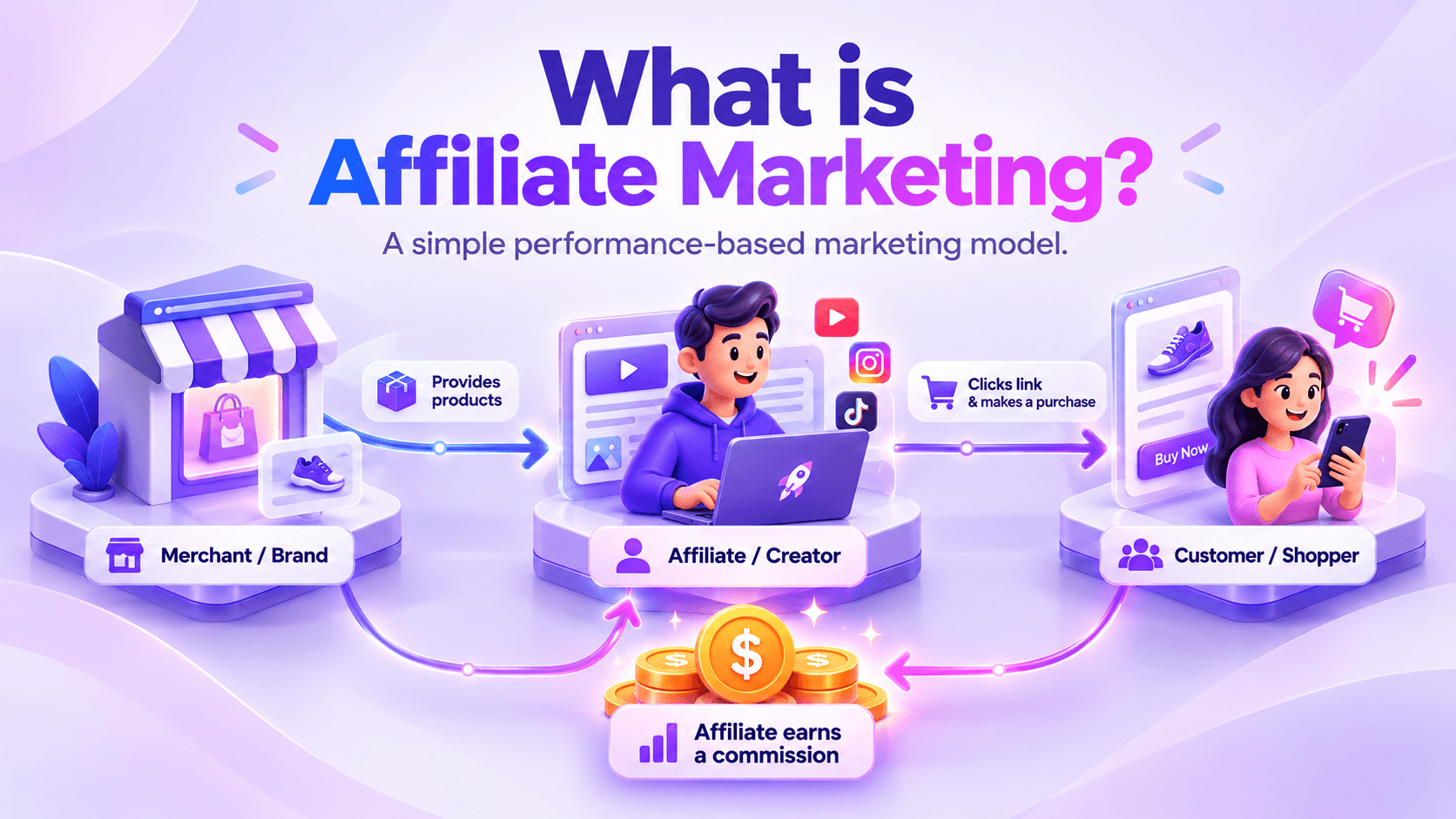
How to Find and Recruit Affiliates That Drive Sales
Find and recruit affiliates with a practical guide to partner research, audience checks, outreach scripts, onboarding, activation and sales-focused reporting.
Affiliate recruitment · Reviewed 31 October 2026
How to Find and Recruit Affiliates That Actually Drive Sales
You can approve dozens of affiliates and still have no sales. The missing step may be choosing the right partners, getting a placement live or helping the right visitors reach the right product.
We treat affiliate recruitment as a process from discovery to approved sales. This playbook shows you where to find affiliate partners, how to qualify them, what to say and how to help them start promoting.
How do you find affiliates to promote your products?
Find affiliates where your customers already look for advice: product reviews, comparison articles, niche videos, newsletters and relevant communities. Check who covers competing products, search your affiliate platform and consider customers who already publish useful content.
Then assess audience fit, promotional methods and commercial terms. A large following or a network approval does not prove that a partner will generate sales for your business.
A useful first question
Which customer decision can this partner help with? Look for a clear connection between the audience’s problem, the partner’s content and the product you sell.
1. Define the partner you need before building a list
Write a short recruitment brief. Specify the product, buying problem, target market, price range, permitted promotion methods and the support you can offer.
For example, a store selling compact exercise equipment might seek small-space fitness creators and comparison publishers serving countries where it can deliver competitively. A general entertainment account with a much larger audience may be less useful.
- Customer: who buys, where they live and what they need to know.
- Partner: the publisher type and content format that can help.
- Offer: commission, eligible revenue, referral window and payment rules.
- Support: samples, product facts, images, feeds and a contact person.
- First action: a review, comparison inclusion, demonstration or newsletter feature.
Choose partners your offer can support. Commission-only arrangements may suit some publishers, while others charge for production or placement. Keep those costs separate when judging the opportunity.
2. Choose a mix of affiliate publisher types
Different partners help at different points in a purchase. Awin’s partner guidance includes content, creators, email, cashback, loyalty and discount-code publishers. Our suggested qualification questions are below.
| Partner type | Potential role | Qualification question |
|---|---|---|
| Niche blogs and review sites | Explain use cases and compare products. | Do they publish useful, current content about your category? |
| Editorial and comparison publishers | Reach readers researching a purchase. | Which relevant page or placement is realistically available? |
| Creators and video reviewers | Demonstrate products and answer audience questions. | Do their audience and typical content suit the product? |
| Newsletters and communities | Introduce offers to a focused audience. | Can they explain audience fit and how promotion is permitted? |
| Cashback, loyalty and coupon partners | Help shoppers choose an offer or complete a purchase. | Can you assess margin, code distribution and customer overlap? |
| Customer advocates and professional referrers | Recommend products through relevant experience. | Do they have a suitable channel or referral setting? |
There is no universal recruitment order. A product that needs explanation may benefit from demonstrations. A widely recognised retail brand may have different needs. Match the mix to the buying decision and measure what follows.
3. Find affiliate partners through five research routes
Study competitor coverage
Search for competing product reviews, alternatives and category buying guides. Record the actual page, its audience and why your product could belong there. Public coverage is a prospecting clue; it does not prove an active affiliate agreement.
Search patterns to adapt
best [product category] for [use case]
[competitor brand] review
[competitor product] alternatives
[product category] comparison [target country]
site:youtube.com [product category] review
Check whether the page is maintained and whether it covers your customer’s problem. Backlink tools can uncover candidates, but a backlink alone does not establish audience quality, affiliate status or sales.
Search your network or platform
Awin supports partner discovery by promotional type, sector and region. impact.com describes discovery, vetting and prospect groups. CJ provides publisher recruitment tools. Use these to create a shortlist, then review the partner’s actual properties and proposal.
Feature access varies by account and plan. Recommendations and profile data help you investigate; they do not replace your own checks or predict your results.
Look for niche creators
Search the questions your customer asks, then review creators answering them. Look at several recent posts and the normal range of views. Separate giveaways, paid boosts and unusual viral posts when judging likely reach.
Ask for recent platform analytics where available. A creator’s home country is not the same as their audience location. Comments can reveal useful interests, but they cannot verify audience demographics on their own.
Review existing customers and brand mentions
Customers who already explain how they use your product may be suitable advocates. Ask whether they want an affiliate relationship and how they would share it. Being a satisfied customer does not automatically make someone a publisher.
Make your program easy to find
Publish an affiliate page explaining eligibility, terms and how to apply. Link to it from a sensible place on your site. An application form should ask for promotional properties, target markets and the proposed traffic source, not just a name and email.
4. Qualify partners before sending an invitation
We suggest a simple scorecard to keep decisions consistent. Score each area from 0 to 2: 0 for no supporting evidence, 1 for partial evidence and 2 for clear evidence.
| Check | Evidence to look for |
|---|---|
| Audience fit | Relevant interests and reachable markets, supported by current information. |
| Buying intent | Content that helps readers choose, compare or use your type of product. |
| Content quality | Useful explanations, credible demonstrations and maintained pages. |
| Traffic transparency | A clear description of the sites, accounts or methods used. |
| Commercial fit | Commission, fees and support that your economics can sustain. |
| Activation plan | A specific first placement, required resources and a plausible timeline. |
Suggested internal triage: prioritise scores of 9-12, investigate scores of 6-8 and pause lower scores. This is a working framework, not a validated sales predictor. Missing information is a reason to ask questions.
Check the details a score can hide
Confirm that the applicant controls the site or account listed. Check business contact details, review recent promotional activity and ask about paid search, coupon distribution or sub-affiliate traffic where relevant. Investigate unexplained spikes or inconsistent figures rather than declaring fraud from one signal.
A strong overall score should not override an undisclosed traffic source or a plan that conflicts with your terms. Request clarification before approval.
5. Give qualified affiliates a reason to join
Your offer needs more than a percentage. Explain which products suit the audience, what makes them useful, how referrals are credited and what support is available.
A partner evaluating your program may consider expected earnings per visit, product demand, website conversion, returns and payment reliability. Those factors cannot all be known before a test, so provide facts without inventing earnings projections.
- State the commission rate and what revenue qualifies.
- Explain the referral window, review period and payout process.
- Offer suitable assets and samples where agreed.
- Confirm current stock, delivery markets and offer restrictions.
- Give the partner one clear contact and a realistic next step.
If you pay a content or placement fee, agree the deliverable, publication timing, reporting and any usage rights separately. Buying a video for your own ads is different from asking a creator to drive referrals through their audience.
6. Personalise outreach around a real opportunity
Use one specific observation from the partner’s work. Connect it to a product and propose a useful next step. Replace every bracketed field in the scripts below and include only terms you can honour.
Publisher outreach script
Subject: [Brand] for your [specific guide]
Your guide to [topic] helps readers compare [specific feature]. Our [product] may suit readers who need [use case] because [verifiable product fact].
We offer [commission] on [eligible revenue], with a [referral window] and [payment terms]. We can share [sample or relevant resources].
Would you like the details to assess whether it fits a future update?
Creator outreach script
Your [specific video] explains [topic] clearly. We think [product] could fit your [audience or content series].
We offer [commission], [sample if available] and [audience offer if approved]. We would discuss a [demonstration or review] with a tracked link, while leaving your honest opinion to you.
Are you open to affiliate partnerships, and do you charge a separate content fee?
Use the partner’s published business contact or the relevant platform inbox. Identify your brand clearly, keep records of replies and honour requests to stop contact. Tailor the channel and message to applicable outreach rules.
7. Follow up with a reason, then close the loop
A reminder should remove a barrier or add useful context. Repeating the original invitation several times does not create a stronger offer.
| Example timing | Purpose |
|---|---|
| Day 0 | Send a researched invitation with one clear question. |
| Around day 5 | Check interest and add a relevant product fact or content angle. |
| Around day 12 | Ask whether timing, terms or the offer is the blocker. |
| Around day 21 | Close the thread or agree a later date if the partner responds. |
This is a suggested cadence, not an industry benchmark. Adjust for editorial calendars and existing conversations. Stop if someone declines or asks not to be contacted.
Follow-up script
Following up on [product] for your [guide or series]. One detail that may help is [useful fact or resource].
Would you like the program terms, or is the timing unsuitable? If this is not relevant, let me know and I will close the thread.
8. Turn approvals into live promotion
Onboarding means making it possible to promote. Activation means the partner takes a measurable step. We recommend reporting traffic activity and approved-sales activity separately.
- 01 · Confirm the plan Agree the first placement and next review date.
- 02 · Supply resources Send tested links, product facts and agreed samples.
- 03 · Verify publication Record the live page or post and check its destination.
- 04 · Review results Inspect relevant traffic, orders and any blockers.
For each new partner, send the terms, product links, permitted claims, disclosure guidance and support contact in one place. Test the referral journey using your provider’s process. Awin, for example, documents a test transaction and technical review.
For US-facing endorsements, the FTC calls for clear, conspicuous disclosure of the affiliate relationship. Give partners plain wording and check how it appears with the recommendation. Free samples can also create a connection that needs disclosure.
Activation message
Your [Brand] application is approved. Here are your [tracking link], [terms] and [product resources].
Which product or placement would you like to start with? If we agree a sample, please confirm the delivery details. We can review the link together before you publish and check progress on [agreed date].
9. Measure the recruitment funnel
Record the partner’s unique ID, promotional properties, contact, type, target audience, qualification evidence, outreach dates, agreed terms, live placements and next action. Keep lifecycle stage separate from follow-up status.
| Metric | Definition | What it helps diagnose |
|---|---|---|
| Response rate | Unique responding prospects divided by unique contacted prospects. | Relevance, contact quality and offer clarity. |
| Traffic activation rate | Approved partners in a cohort sending non-test clicks during the stated window, divided by that cohort’s approved partners. | How well approvals turn into activity. |
| Sales-active partners | Partners with at least one approved, non-test order in the stated period. | How widely validated sales are distributed. |
| Conversion rate | Eligible orders divided by the stated click or session count. | Traffic and buying-path performance; label the order status used. |
| Approved revenue and contribution | Approved revenue and the amount left after defined product, fulfilment and channel costs. | Whether reported sales support the business. |
Example: If 40 partners in an approval cohort have had 30 days to activate and 10 send non-test clicks in that window, traffic activation is 25%. If only 2 generate approved orders, report those 2 separately. These are illustrative figures, not targets.
Do not compare a week-old approval cohort with partners who have had months to publish. Allow for the validation delay when analysing recent orders. Keep pending sales visible without treating them as approved revenue.
Why are your affiliates not generating sales?
Find the first weak stage before recruiting more partners or raising commission. Zero sales can have several causes, and more than one may apply.
| What you see | What to check next |
|---|---|
| No replies | Contact accuracy, partner fit, message relevance and commercial terms. |
| Approvals without live placements | Missing samples, unclear next steps, editorial timing or lack of interest. |
| Live placements without clicks | Visibility, link function, audience relevance and clarity of the recommendation. |
| Clicks without tracked orders | Internal tests or invalid traffic, attribution, product-page fit, delivery, price and checkout. |
| Tracked orders without approval | Review timing, returns, cancellations, policy issues and data mismatches. |
Compare th

 Skyler White